Saturday, July 30, 2016

FBI Investigation Documents of IRS Scandal

Reveal Top Washington IRS Officials Knew About Targeting of “Tea Party” Groups Two Years Before Disclosing it to Congress and Public

FBI interview with IRS senior official reveals: “he thought the cases were being pulled based upon political affiliations”


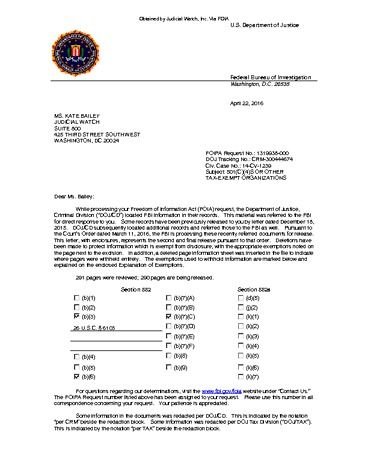
WASHINGTON (JW) – Judicial Watch today released 294 pages of new Federal Bureau of Investigation (FBI) “302” documents revealing that top Washington IRS officials, including Lois Lerner and Holly Paz, knew that the agency was specifically targeting “Tea Party” and other conservative organizations two full years before disclosing it to Congress and the public. An FBI 302 document contains detailed narratives of FBI agent investigations. The Obama Justice Department and FBI investigations into the Obama IRS scandal resulted in no criminal charges.

The FBI 302 documents confirm the Treasury Inspector General for Tax Administration (TIGTA) 2013 report that said, “Senior IRS officials knew that agents were targeting conservative groups for special scrutiny as early as 2011.” Lerner did not reveal the targeting until May 2013, in response to a planted question at an American Bar Association conference. The new documents reveal that then-acting IRS Commissioner Steven Miller actually wrote Lerner’s response: “They used names like Tea Party or Patriots and they selected cases simply because the applications had those names in the title. That was wrong, that was absolutely incorrect, insensitive, and inappropriate.”

The FBI documents also reveal that IRS officials stated that the agency was targeting conservative groups because of their ideology and political affiliation in the summer of 2011. According to one senior tax law specialist, “The case seemed to be pulled because of the applicant’s political affiliation and screening is not supposed to occur that way … [Redacted] said he thought the cases were being pulled based upon political affiliations.” And IRS senior official Nancy Marks, appointed by Miller to conduct an internal investigation stated, “Cincinnati was categorizing cases based on name and ideology, not just activity.”

Judicial Watch obtained the new documents through a federal court order in a Judicial Watch Freedom of Information Act (FOIA) lawsuit (Judicial Watch v Department of Justice (No. 1:14-cv-01239)).

According to the FBI documents, Paz and others were informed in the late spring and summer of 2011 that Cincinnati agents were using “BOLO” (Be On the Look Out) briefing guides that instructed them to be “looking at cases using the Tea Party term.” The IRS failed to reveal such targeting until the ABA conference in May 2013:

The FBI reports that in its interview with an unidentified IRS Senior Tax Law Specialist:

She read how the case was screened and it was not because of the organization’s activity. The case seemed to be pulled because of the applicant’s political affiliation and screening is not supposed to occur that way.… She wanted to alert the managers about the way the cases were being pulled…. [Redacted] said he thought the cases were being pulled based upon political affiliations.… [Redacted] then went to tell [Redacted] said he would follow up on the issue and would let HOLLY PAZ know this was possibly occurring. This occurred in the mid to late March or April 2011 timeframe.

***

The cases were labeled as Tea Party cases. The screening sheets said the two cases were pulled because of the names and political affiliations.

The FBI reports that in its interview with unidentified IRS Technical Advisor who reported directly to Lerner:

[Redacted] attended a meeting in the summer of 2011. She was not invited, but she was talking to LERNER about something else in the office when LERNER mentioned that it would be interesting for her to attend … Only people from Washington, D.C. were in the room, to include HOLLY PAZ … At the meeting, it was disclosed that one of the ways Cincinnati was looking for cases was using the “Tea Party” term. They were calling the body of cases involving political activity “Tea Party” cases. The concern was that the IRS had put a label on the cases that would be problematic.

The FBI reports that in its interview with an unidentified IRS Acting Manager of Exempt Organizations Technical (EOT):

In his meeting concerning the briefing in mid-June [2011] [Redacted] met with EOT and EOG [Exempt Organizations Group] staffs and PAZ…. They showed PAZ the briefing paper and the use of the Tea Party term. PAZ was the highest ranking person at the meeting.… Somebody said they may not want to use Tea Party as a labeling term. [Redacted] had recognized they may not want to use the term Tea Party when they were doing the briefing paper, but his plan was to raise the issue with PAZ at the briefing. He does not recall PAZ’s reaction.

According to a ten-page section of the documents containing the FBI interviews with IRS Senior Technical Advisor Nancy Marks, in the spring of 2012, Miller asked Marks to “look into how these 501 (c)(4) cases were being handled and find out what the problems were.” After investigations in Washington and Cincinnati, Marks reported the following to Miller in May 2012 according to the FBI:

It was not until much later that MARKS saw information that [Redacted] was only looking for Tea Party cases…. The BOLO [Be on the Lookout] showed that at various points the criteria called for “Tea Party” name, and then later the ideology…. She told him [Miller, on May 3, 2012] that Cincinnati was categorizing cases based on name and ideology, not just activity. When MARKS told MILLER this, he threw his pencil across the room and said, “Oh shit.”

The FBI documents also reveal that the FBI investigated why Holly Paz, the IRS Acting Director of Rulings and Agreements in 2011, sat in on numerous of the Treasury Inspector General for Tax Administration (TIGTA) interviews with lower level IRS employees and if her presence improperly influenced the employees’ responses to investigators’ questions. The documents repeatedly state, “Other than the auditors, the only person present during the [Redacted] interview was HOLLY PAZ.”

The documents contain two separate lengthy FBI interviews with Lois Lerner, the first in October 2013 and the second in July 2014. Both interviews came after Lerner invoked her Fifth Amendment constitutional right against self-incrimination before the House Oversight Committee in May 2013. By answering questions under oath in her FBI interviews, Lerner seemed to undermine her earlier Fifth Amendment-based refusal to testify to Congress, since witnesses generally cannot invoke the right in one instance and not another. The House voted to hold Lerner in contempt of Congress for her refusal to testify.

And the FBI 302 documents also contain an interview in which Miller reveals that former IRS Commissioner Douglas Shulman very likely misled Congress in his March 22, 2012, testimony before the House Ways and Means Committee when he said, “There is absolutely no targeting.” According to the FBI report on the Miller interview, “In February or March, MILLER talked to SHULMAN about the development letters.” The “development letters” were letters sent by the IRS primarily to targeted conservative groups seeking what the Treasury Inspector General for Tax Administration (TIGTA) later termed “inappropriate” information about websites and donors.

“These new smoking-gun documents show Obama FBI and Justice Department had plenty of evidence suggesting illegal targeting, perjury, and obstruction of justice,” said Judicial Watch President Tom Fitton. “Both the FBI and Justice Department collaborated with the Lois Lerner and the IRS to try to prosecute and jail Barack Obama’s political opponents. These FBI documents show the resulting compromised investigation looked the other way when it came to Obama’s IRS criminality.”
Page 1: JW v DOJ Corrected Full Release 302s  01239

Friday, July 29, 2016

Full List of Hillary’s Planned Tax Hikes

Hillary Clinton has made clear she intends to dramatically raise taxes on the American people if elected.


WASHINGTON (ATR) - She has proposed an income tax increase, a business tax increase, a death tax increase, a capital gains tax increase, a tax on stock trading, an "Exit Tax" and more (see below). Her planned net tax increase on the American people is at least $1 trillion over ten years, based on her campaign’s own figures.

Hillary has endorsed several tax increases on middle income Americans, despite her pledge not to raise taxes on any American making less than $250,000. She has said she would be fine with a payroll tax hike on all Americans, she has endorsed a steep soda tax, endorsed a 25% national gun tax, and most recently, her campaign manager John Podesta said she would be open to a carbon tax. It’s no wonder that when asked by ABC's George Stephanopoulos if her pledge was a "rock-solid" promise, she slipped and said the pledge was merely a “goal.” In other words, she's going to raise taxes on middle income Americans.

Hillary’s formally proposed $1 trillion net tax increase consists of the following:

Income Tax Increase – $350 Billion: Clinton has proposed a $350 billion income tax hike in the form of a 28 percent cap on itemized deductions.

Business Tax Increase -- $275 Billion: Clinton has called for a tax hike of at least $275 billion through undefined business tax reform, as described in a Clinton campaign document.

“Fairness” Tax Increase -- $400 Billion: According to her published plan, Clinton has called for a tax increase of “between $400 and $500 billion” by “restoring basic fairness to our tax code.” These proposals include a “fair share surcharge,” the taxing of carried interest capital gains as ordinary income, and a hike in the Death Tax.

But there are even more Clinton tax hike proposals not included in the tally above. Her campaign has failed to release specific details for many of her proposals. The true Clinton net tax hike figure is likely much higher than $1 trillion.

For instance:

Capital Gains Tax Increase -- Clinton has proposed an increase in the capital gains tax to counter the “tyranny of today’s earnings report.” Her plan calls for a byzantine capital gains tax regime with six rates. Her campaign has not put a dollar amount on this tax increase.

Tax on Stock Trading -- Clinton has proposed a new tax on stock trading. Costs associated with this new tax will be borne by millions of American families that hold 401(k)s, IRAs and other savings accounts. The tax increase would only further burden markets by discouraging trading and investment. Again, no dollar figure for this tax hike has been released by the Clinton campaign.

“Exit Tax” – Rather than reduce the extremely high, uncompetitive corporate tax rate, Clinton has proposed a series of measures aimed at inversions including an “exit tax” on income earned overseas. The term “exit tax” is used by the campaign itself. Her campaign document describing this proposal says it will raise $80 billion in tax revenue, but claims some of the $80 billion will be plowed into tax relief. How much? The campaign doesn't say.

This proposal completely fails to address the underlying causes behind inversions: The U.S. 39% corporate tax rate (35% federal rate plus an average state rate of 4%) and our "worldwide" system of taxation, which imposes tax on all American earnings worldwide. The average corporate rate in the developed world is 25%. Thirty-one of thirty-four developed countries have cut their corporate tax rate since 2000. The U.S. has not. Hillary's plan moves in the wrong direction.

ATR is tracking Clinton’s full tax record at its dedicated website here


In Secret Battle, Surveillance Court Reined in FBI Use of Information Obtained From Phone Calls

For over 10 years, the country’s surveillance court intervened to limit the FBI’s ability to act on sensitive information that it collected while monitoring phone calls.
 
By: Jenna McLaughlin


WASHINGTON (TheIntercept) - Beginning over a decade ago, the country’s surveillance court intervened to limit the FBI’s ability to act on some sensitive information that it collected while monitoring phone calls.

The wrangling between the FBI and the secret court is contained in previously undisclosed documents obtained by the Electronic Privacy Information Center, or EPIC. The documents, part of an ongoing Freedom of Information Act lawsuit, were shared with The Intercept.

The documents reveal that the Foreign Intelligence Surveillance Court (FISA) told the FBI several times between 2005 and 2007 that using some incidental information it collected while monitoring communications in an investigation — specifically, numbers people punch into their phones after they’ve placed a call — would require an explicit authorization from the court, even in an emergency.

“The newly obtained summaries are significant because they show the power that the [Foreign Intelligence Surveillance Court] has to limit expansive FBI surveillance practices,” Alan Butler, an attorney for EPIC, wrote in an email to The Intercept.

Additionally, The Intercept independently obtained sections of the FBI’s 2011 Domestic Investigations and Operations Guide describing how the FBI currently deals with information it obtains after getting a court order for what’s called a “pen register,” or “trap and trace” on a target — a capability built into the phone lines that records incoming and outgoing phone numbers for a particular phone. The 2011 guide is currently public but heavily redacted.

The Operations Guide, in addition to shedding light on how the FBI uses pen registers, reveals that the surveillance court’s pushback more than a decade ago has become internal FBI policy.

During an investigation, the FBI is often interested in who a target is talking to — what calls they make and receive, and where those calls physically originate.

By simply telling a judge the information is “relevant,” the FBI can demand that a phone company, or email or other online provider, immediately hand over any and all “telephone numbers, email addresses, and other dialing, routing, addressing, or signaling information.” That information can sometimes include locational data. They don’t need to notify the target or demonstrate probable cause that he or she committed a crime to get it.

But the FBI’s monitoring can end up getting more information than just phone numbers, though pen-register and trap-and-trace orders are not intended to get any “content” that would provide insight into the substance or subject of a communication.

For example, the numbers people punch into the phone after making a call can reveal financial or personal information — like a credit card number, a social security number, a PIN, a prescription number, or any other type of response via automated telephone prompts. The “term of art” for this information is “post-cut-through dialed digits.”

The FBI in the 2011 Domestic Investigations and Operations Guide has described the digits dialed after someone makes a call as “content.”

Following the release of documents by NSA whistleblower Edward Snowden, many have described the secretive court as a “rubber stamp” because it rarely rejects a surveillance request. But there’s nuance in what the judges have challenged or modified in response to requests over the years.

Between July and December in 2005, the surveillance court approved pen registers and trap-and-trace devices to target “at least 138” people.

However, one judge started asking the FBI more probing questions about what exactly it did with post-cut through dialing digits it “incidentally” obtained with those orders — launching what Butler describes as an “open secret” fight between the Foreign Intelligence Surveillance Court and FBI over the information. The judge’s request for a “memorandum of law” appears in the July 2006 Department of Justice report to Congress on its use of FISA pen registers, obtained by EPIC. Some of that pushback was documented by Wired in 2008.

In May 2006, the government told the court that it had the authority to collect that sensitive information, and would “in some cases … specifically seek authority for secondary orders requiring a service provider to provide all dialing, routing, addressing or signaling information transmitted by a target telephone, which, in light of technological constraints, may include content and non-content digits alike,” the report continues. (According to the Domestic Investigations and Operations Guide, the FBI agent requesting the pen register has to specifically ask for any additional dialing information following the first nine or 10 digits — it isn’t automatic.)

The government also insisted it wouldn’t actually use that information in an investigation — unless there’s an emergency, that is, to prevent death, serious physical injury, or “harm to national security,” though it’s never made explicit what exactly that means.

Between January and June in 2006, the surveillance court modified some of the FBI’s applications to stop it from using that information without additional permission, no matter the urgency.

The court “had made modifications to the government’s proposed pen register orders,” reads the biannual report to Congress obtained by EPIC. “Although the [FISA Court] has authorized the government to record and decode all post-cut-through digits dialed by the targeted telephone, it has struck the language specifically authorizing the government to make affirmative investigative use of possible content” unless permission is specifically granted by the court.

The surveillance court wasn’t the only judicial body rejecting the FBI’s requests to hold on to the additional dialing information. In July 2006, a magistrate judge in Texas denied an application for a pen register because filtering technology would not eliminate the additional content information. That led then-chief judge of the surveillance court, Colleen Kollar-Kotelly, to ask the government to respond to the Texas court, and explain how it might impact decisions in foreign intelligence investigations.

The government said the court should basically ignore the decision — and take note of new revisions to the USA Patriot Act, which said the government could obtain “noncontent” dialing information. (Because there isn’t technology that can reliably separate out content from noncontent when it comes to this type of dialing information, the law basically allows for all of it, the government argued.)

In 2006, the court had not yet written a formal decision on whether or not the government could keep getting this information — let alone use it in an investigation.

But “most” of the judges continued to strike the “emergency” language from the FBI’s requests, despite the government continuing to insist that “the proposed exception is reasonable under the Fourth Amendment” because its use is so rare.

By August 2006, the court asked the FBI to produce an entire report on how the dialing information obtained through pen registers is stored and kept in its databases. By 2007, the court reported that it modified 18 different government requests out of 98 within six months.

The secret court continued to delete language that would allow the government to use the post-cut-through dialed digits in an emergency — and added a time limit on when it could come back to ask to use that content.

By 2011, the court’s resistance appeared to enter into formal policy, according to the Domestic Investigations and Operations Guide section obtained by The Intercept. The FBI, the guide states, can never in these cases use information like credit card numbers or social security numbers obtained after dialing a phone number, “even in cases of emergency.”

However, that exception still applies in criminal cases, according to the 2011 Operations Guide. “In an emergency,” information obtained from the numbers people dial “may be used as necessary in criminal investigations to prevent immediate danger of death, serious physical injury, or harm to national security,” reads the section on post-cut through dialing digits. And if the target is calling a bank, for example — the FBI cannot get the account number from the call, but it can use the call as a lead and subpoena the bank for that information instead.

Butler points out that despite the FBI and the secret court’s fight over the information, it is basically impossible to tell whether that information triggered investigative leads agents wouldn’t have otherwise had without the pen register.

The FBI declined to comment on the previously redacted portions of the 2011 Domestic Investigations and Operations Guide obtained by The Intercept as well as the FOIA documents obtained by EPIC.

“The Domestic Investigations and Operations Guide establishes the FBI’s internal rules and procedures, and describes the FBI’s authority to use specific investigative tools as determined through the Constitution, U.S. statutes, executive orders, and the AG Guidelines for Domestic FBI Operations,” Chris Allen, an FBI spokesperson, wrote in an email. “These rules are audited and enforced through a rigorous compliance mechanism designed to ensure that FBI assessments and investigations are subject to responsible review and approval.”


Merkel admits EU is being RAVAGED BY TERROR but says Germany should welcome MORE refugees

CHANCELLOR Angela Merkel has said Germany is facing a “major” threat from terrorism but that this should not stop refugees being welcomed to Europe.

German Chancellor Angela Merkel


The German leader, who cut short her summer holiday to speak after a string of Islamist attacks rocked the country, said the entire continent was being “ravaged” by terrorism.
She described recent attacks in Ansbach, Wurzburg and Munich as “horrifying and depressing” but insisted Germany would not turn its back on people fleeing the Middle East. 
In the wake of the killings, Mrs Merkel said Germany now needed a better “early warning system” to spot radicalised Muslims among the newly-arrived migrants.

She said the central government would “redouble its efforts” against the threat, increasing staff numbers and resources for security services.

She said: "The terrorists want to make us lose sight of what is important to us, break down our cohesion and sense of community as well as inhibiting our way of life, our openness and our willingness take in people who are in need.
"They see hatred and fear between cultures and they see hatred and fear between religions. 
“We stand decisively against that.”

She added that Germany would "stick to our principles" and "give shelter to those who deserve it".

Economists have warned that Germany's shrinking population could hit growth and many now believe Mrs Merkel's fondness for large-scale migration is aimed at ensuring the country maintains its working-age population. 
However, she also hinted that Germany would act in the future to limit the numbers that were arriving at its borders. 

Asked if reducing the flow of migrants was a priority, Mrs Merkel responded: “Yes of course this is one of my objectives, immigration from last year was marked by a illegal immigration, human trafficking, and this is not something that we can accept. 

“Thousands die in the Mediterranean and we have said two things: first that we have to legalise the flow and that is why the voluntary agreement with Turkey contains humanitarian quotas, and also…a country like Germany, as strong as Germany, can not continue to take in such a flow of migrants and we have to limit the numbers. 

“We say that the refugees can lead a good life close to their homes and that is why three billion euros are earmarked for refugees in Turkey. 

“This is our responsibility, i am convinced of that. 

But she continued: “I am not going to say that we are going to welcome any more refugees, but we have to work hard to combat the root causes.”

Speaking defiantly amid the escalating poltiical and security crisis in Germany, Mrs Merkel repeated several times the mantra "We can do this" after spelling out the "major litmus test" that the country was now facing.

She also spoke of speeding up the process of sending home failed asylum seekers, after it emerged the Syrian migrant who detonated explosives near a music festival in Ansbach was refused the right to stay in Germany. 

In an admission of the dangers the migrant crisis has posed to security in Europe, Mrs Merkel also said that attacks in Paris last November was proof that terrorist fighters were being smuggled in among the flow of people arriving from the Middle East and Africa.

She said the attacks had “mocked” Germany and damaged the reputation of the majority of refugees in the country, who are law-abiding.

The German government will now look to take “additional measures” to counter the jihadi threat, although Mrs Merkel refused to be rushed into outlining exactly what these might be. 

Germany must conduct a comprehensive review before taking any steps in response to the attacks, she said. 

Mrs Merkel added: “These events create major concern and fears, but fears cannot inform us in political action and I will do my utmost to prevent these attacks from happening again. 
“We are not the only ones [affected by terrorism]. Governments need to live up to their responsibilities to restore confidence.”

A spate of attacks since July 18 has left 15 people dead - including four attackers - and dozens injured.

Two assailants, a Syrian asylum seeker and a refugee from either Pakistan or Afghanistan, had links to Islamist militancy, officials say.
The attacks have burst any illusions in Germany that the country is immune to attacks like those claimed by ISIS in neighbouring France.

 German Chancellor Angela Merkel poses for the media as she arrives at a press conference in Berlin

 Merkel
Critics of Mrs Merkel say her refugee policy is at fault, after more than a million migrants entered Germany in the past year.

Was the CIA behind the failed Turkish coup?

Turkey's failed coup was financed by the CIA and directed by a retired U.S. army general using a cell in Afghanistan, said one Turkish pro-government newspaper. CIA agents used an island hotel off Istanbul as a nerve center for the plot, said another.
 

 By:  Michael Georgy and Mert Ozkan


ISTANBUL/ANKARA |  (Reuters) - Turks are churning out conspiracy theories about who helped orchestrate the abortive military coup that nearly toppled President Tayyip Erdogan, with the United States - a close NATO ally but a traditional object of suspicion - top of the list.

"The coup was directed by this man," said a front-page headline in the pro-government Yeni Safak newspaper, alongside a photo of retired U.S. Army General John F. Campbell, the last commander of NATO-led forces in Afghanistan and before that the 34th vice chief of staff of the U.S. Army.

It said the failed coup had been financed by the CIA via Nigeria's United Bank for Africa (UBA.LG), and that two Afghan-based Turkish generals detained in Dubai on Tuesday were part of Campbell's cell of plotters.

UBA on Wednesday denied involvement and said the accusations were "clearly false". Campbell told the Wall Street Journal that the allegations were "absolutely ridiculous" and Washington has dismissed claims of U.S. involvement as absurd.

Erdogan has blamed U.S.-based Muslim cleric Fethullah Gulen for masterminding the attempted coup, which killed more than 240 people as rogue soldiers commandeered fighter jets, helicopters and tanks, and has called on Washington to extradite him.

Erdogan accuses Gulen of building a "parallel structure" in the judiciary, education system, media and military in a bid to overthrow him, a charge the 75-year-old cleric denies. A poll on Tuesday showed two thirds of Turks believe Gulen was behind the coup plot, though only 3.8 percent blamed the United States.

Prime Minister Binali Yildirim has said any country that stands by the cleric would be considered at war with Turkey. Labour Minister Suleyman Soylu said a day after the coup bid that it was clear "America is behind it", though Erdogan's spokesman later said he had spoken "in the heat of the moment".

Washington has said it will only extradite Gulen if Turkey provides evidence of wrongdoing.

For Erdogan's fervent supporters, such apparent reluctance is further evidence of U.S. complicity.

"I know that the United States has a finger in this. I know that this is a play put on by the United States, Israel and the United Kingdom," said Ahmet Demirci, among the dozens of people to have gathered in solidarity outside Erdogan's palace night after night since the July 15 coup attempt.

"That dishonest man, Fethullah Gulen is their pawn."

Older Turks recall past coups. Many see evidence that the United States backed a 1980 coup, at the height of the Cold War, citing reports that the CIA station chief in Ankara cabled Washington to say "our boys did it".

Mystery still shrouds modern Turkey's first coup in 1960 which overthrew a pro-American prime minister but was led by a U.S.-trained officer.

One newspaper published a photograph of a hotel it identified as a nerve center for CIA agents it said helped hatch the coup plot this month.

"The CIA was at work in this hotel that night," the headline in the pro-government Sabah newspaper said, above a photo of the Splendid Hotel on Buyukada, the largest of a group of islands in the Marmara sea just off Istanbul.

The paper said a group of 17 people, mostly foreigners, checked in at the hotel on the day of the coup attempt. It said the hotel was used as a headquarters for the British army during its occupation of Istanbul in 1919.

CONSOLIDATING POWER

A successful overthrow of Erdogan, who has run the country of about 80 million people since 2003, could have sent Turkey spiraling into conflict. The intrigue in the aftermath is helping justify a wide crackdown, analysts say, with more than 60,000 soldiers, police, civil servants and other officials detained, suspended or under investigation.

"This has helped him strengthen his position," said Andrew Finkel, a journalist and political analyst based in Turkey since 1989. "He is doing what he does best, consolidating power."

Conspiracy theories have spiced up Turkish crises for decades amid the struggle between Islamists and secularists to shape the country, with superpower America often accused of fuelling the fire. Erdogan blamed foreign powers for stirring up nationwide anti-government protests three years ago.

Sometimes the perceived enemy is less formidable.

During contentious local elections in 2014, seen as a referendum on Erdogan's rule, power cuts disrupted the count. Turkey's energy minister blamed a cat, saying it had walked into a transformer unit, drawing ridicule from social media users who portrayed a "cat lobby" threatening the government.

In 2013, authorities detained a bird on suspicion it was spying for Israel, but freed it after X-rays showed it was not embedded with surveillance equipment, local newspapers said.

Nevertheless, Turks take their conspiracies seriously and the latest tensions are providing fresh material.

Gulen lives in a secluded compound in Pennsylvania's Pocono Mountains. But Erdogan has good reason to worry about the reclusive cleric's reach inside Turkey.

In 2013, his followers in the police and judiciary opened a corruption probe into business associates of Erdogan, then prime minister, who denounced the investigations as a foreign plot.

"Why don't they hand him over? Why do they keep making insinuations? He (Gulen) lives there. Don't you think this is an apparent indicator? This is the impression people have," said Erdogan supporter Ayhan Onkibar outside the presidential palace.

"Why does he live in the United States? These are details we notice."

Tuesday, July 26, 2016

A generation of poisoning with gender-bender chemicals has created a new class of youth who fail to

The success of the globalists in perverting the minds of Western youth is evident in a new study by the Innovation Group, which found that most people between the ages of 13 and 20 – what the mainstream media and social engineers have dubbed "Generation Z" – no longer believe in strictly-defined gender identities like "male" and "female."

 
By: Ethan A. Huff


WASHINGTON (NaturalNews) - These gender "binaries," which are really just the pronouns humanity has been using since the beginning of time to differentiate between individuals with external reproductive equipment versus internal reproductive equipment, are now "old-fashioned" to the youth of today, which the study found are more comfortable than previous generations using gender-neutral (and grammatically incorrect) pronouns like "they" and "them" to describe a single, genderless individual.

A majority of Gen-Z respondents, 52 percent, indicated that they aren't completely heterosexual, while 35 percent – an 11 percent increase compared to "Millennials" – admit that they fall somewhere along the spectrum of bisexuality. This spectrum identification for sexuality is further reflected in the more than 38 percent of Gen-Zers who claim they don't believe gender defines a person.

As far as the types of clothes and accessories they buy, 13–20 year-olds are much more fluid when it comes to sticking to a gender norm. Only 44 percent of Gen-Zers buy clothes exclusively designed for their own gender, while an astounding 70 percent say they support the idea that bathrooms become "genderless," welcoming anyone and everyone who wants to use them.

Gen-Z is likewise more accepting of others who don't identify by any specific gender pronoun, or who identify by "non-traditional" gender pronouns like "ze;" 74 percent of Gen-Zers fall into this category compared to just 62 percent of older Millennials between the ages of 21–34. But the one thing on which both Gen-Zers and Millennials agree? More people than ever are experimenting with their gender identity.

A 16-year-old pansexual (genderless) student from Nebraska by the name of "Madeleine" told VICE that "it" (for lack of a better pronoun) learned more about gender and identity from its peers than from older people, and that "agender," or no gender at all, is a young people's phenomenon.

"I also notice that people my age are more open to gender and sexuality being fluid and subject to change," Madeleine told VICE. "For a while, I identified as asexual, but as time went on and I changed, I realized that maybe I wasn't that way anymore."

Endocrine-disrupting chemicals are eliminating sex, gender
This lack of clarity about biological identity is a product of two things: relentless media propaganda and chemical poisoning with gender-bending chemicals found in plastics, herbicides and pesticides sprayed on our food, and environmental pollution. Chemicals like bisphenol-A (BPA), glyphosate, soy and other hormone-disruptors are altering human genes and producing next-generation "robot" humans with no gender, and thus no identity.

It's sad, really, because it could have been prevented through reforms that protect the people rather than the chemical and drug industries that produce these toxins. Food, water, air: It's all tainted with endocrine-disrupting chemicals (EDCs) that, more often than not, mimic the effects of estrogen, meaning they deplete testosterone and create hormone imbalances that not only confuse children, but also affect their growth and development.

Young girls are becoming more "masculine," while young boys are becoming more "feminine" – an alchemy of the two sexes both physically and mentally that's changing the landscape of culture and civilization.

Administration’s Syrian Refugee Target Passes 2/3 Mark; 0.3 Percent Christians

Of the July arrivals, 1,501 (99.0 percent) were Sunnis, and three (0.19 percent) were Christians. The other 11 (0.72 percent) were other Muslims.
 
By: Patrick Goodenough


WASHINGTON (XX) - With ten weeks to go until the end of the fiscal year, the Obama administration continues to admit Syrian refugees at an accelerated pace, and has now exceeded two-thirds of President Obama’s target of 10,000 by September 30.
 

The proportion of Christians among those resettled continues to languish below half of one percent, while other non-Sunnis account for just over one percent.

As of Monday, 1,515 Syrian refugees fleeing the civil war in their homeland had been admitted since the beginning of July, and a total of 6,726 since FY 2016 began on October 1, according to State Department Refugee Processing Center data.

Of the July arrivals, 1,501 (99.0 percent) were Sunnis, and three (0.19 percent) were Christians. The other 11 (0.72 percent) were other Muslims.

Of the 6,726 total Syrian refugee arrivals since the beginning of FY 2016, 6,625 (98.4 percent) were Sunnis and 23 (0.3 percent) were Christians – including 15 described simply as “Christian,” five Catholics, two Orthodox and one Greek Orthodox adherent.

The remaining 78 (1.1 percent) comprised 49 refugees described in the data simply as “Moslem,” 17 Shi’a Muslims, 10 Yazidis, one of “no religion” and one “other religion.”

To reach its 10,000 target by September 30, the administration will need to admit average of 1,597 each month for July, August and September. With a week of this month to go, and 1,515 admitted as of early Monday, the July target looks to be easily within reach.

Of the 1,515 refugees from Syria admitted since the beginning of July, 363 (23.9 percent) are men between the ages of 14 and 50, another 322 (21.2 percent) are women aged 14-50, and 784 (51.7 percent) are children aged under 14 – 371 boys and 413 girls.

Their ethnic breakdown is: 1,472 Arabs, 22 Kurds, 18 Turkmen and three Armenians.

Of the 6,726 admitted since in FY 2016, 1,661 (24.6 percent) are men 14-50, while 1,537 (22.8 percent) are women aged 14-50. Another 3,240 (48.1 percent) are children aged under 14, made up of 1,658 boys and 1,582 girls.

Of the 6,726, 6,159 are Arabs, 497 are Kurds, 49 are Turkmen, four are Turks, three are Armenian, two are Syriac, one is Assyrian and 11 are “other.”

The 6,726 Syrian refugees have been resettled across the nation, with the largest groups going to Michigan (782), California (603), Arizona (512), Texas (471), Pennsylvania (429), Illinois (421), New York (367), Florida (329), North Carolina (312) and Ohio (305).

Screening concerns

Obama has rejected Republican concerns about security vetting for Syrian refugees, saying that “they are subjected to the most rigorous process conceivable.”

“There is an entire apparatus of all of our law enforcement agencies and the center that we use for countering terrorism to check and ensure that a refugee is not admitted that might cause us harm,” he said shortly after the Paris terror attack last November prompted fresh concerns about terrorist groups using refugee programs to infiltrate operatives into the West.

The administration says the process takes an average of 18-24 months, although an accelerated effort launched last spring aimed to reduce that to around three months in order to meet the president’s 10,000 target.

Last October FBI Director James Comey raised questions about the difficulties involved in checking backgrounds of refugee status applicants from Syria, telling a House Homeland Security Committee hearing “we can only query against that which we have collected.”

“If someone has never made a ripple in the pond in Syria in a way that would get their identity or their interests reflected in our database, we can query our database until the cows come home but we’re not going to – there’ll be nothing to show up, because we have no record of that person,” Comey said. “You can only query what you’ve collected.”